


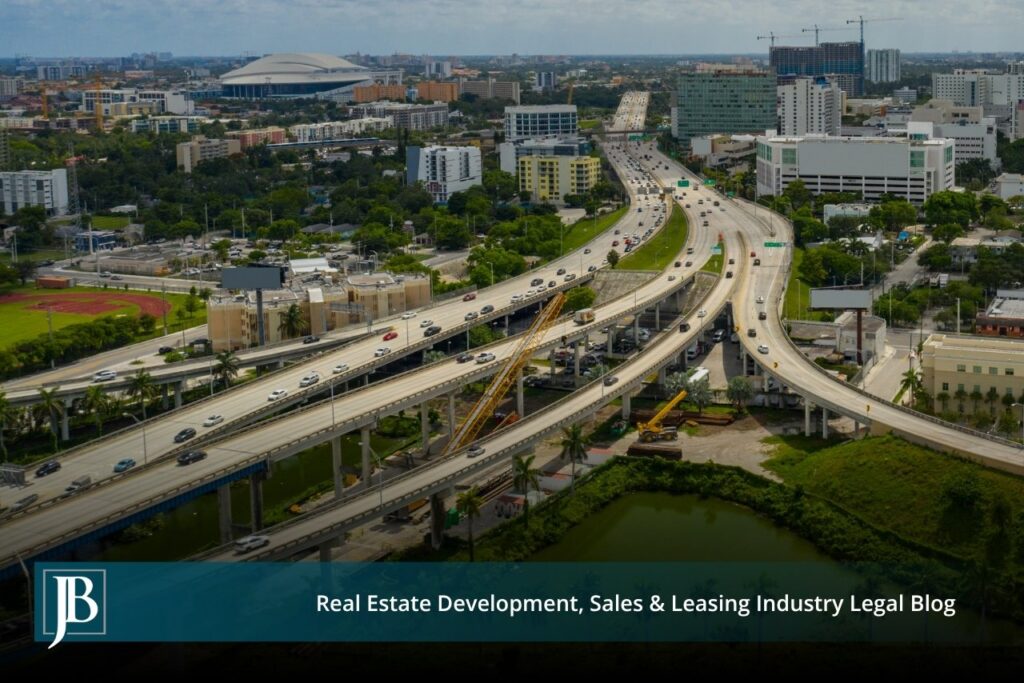
South Florida is in the middle of an infrastructure spending wave that rivals anything Miami-Dade, Broward, and Palm Beach counties have seen this century. Between Governor DeSantis’s Moving Florida Forward Infrastructure Initiative, the Florida Department of Transportation’s (FDOT) FY 2025/26 Work Program, the Florida’s Turnpike Widening Initiative, and the long-running 95 Express buildout, billions of dollars in road, bridge, and interchange work are underway from Florida City to the Treasure Coast.
For commercial property owners, developers, landlords, and small business operators in Miami, Coral Gables, Hialeah, Doral, Miami Beach, Fort Lauderdale, Hollywood, Pompano Beach, Boca Raton, West Palm Beach, and the surrounding cities, this matters for one practical reason. Roads do not get built without land. When FDOT, Florida’s Turnpike Enterprise, the Greater Miami Expressway Agency (GMX, formerly MDX), or a regional partner needs your land, your access, or a strip along your frontage, you are about to become a participant in Florida’s eminent domain process, whether you planned for it or not.
Below is a working summary of the major FDOT and partner-agency projects you should be tracking in 2026, what they mean for nearby property, and how Florida law protects you when the government comes knocking. (For the companion pieces, see our prior posts on Major FDOT Projects You Should Know About in North Florida and Major FDOT Projects You Should Know About in Central Florida.)
Why FDOT’s Footprint Is Growing Right Now
Florida funded a record $13.7 billion FY 2025/26 transportation work program, with major slices reserved for highway and interchange work in FDOT District 4 (Broward, Palm Beach, Martin, St. Lucie, Indian River, and Okeechobee counties) and FDOT District 6 (Miami-Dade and Monroe counties). Statewide, the Moving Florida Forward initiative pulled $4 billion from general revenue surplus and pairs it with leveraged financing, contracting, and design tools to accelerate roughly 20 priority projects. South Florida carries some of the heaviest of those, including the $908 million Golden Glades Interchange overhaul and a Turnpike widening program that touches every county between Florida City and Lake Worth.
That funding velocity is the headline. The quieter story is what happens on the ground. Right-of-way (ROW) acquisition, temporary construction easements, drainage takings, slope easements, and full-parcel condemnations are all being negotiated right now along the corridors below. If your property sits along any of them, the negotiation cycle has likely already started or is close to it.
Miami-Dade and Greater Miami: Projects Worth Watching
1. The Golden Glades Interchange (GGI) Project
The single largest active infrastructure push in Miami-Dade is the Golden Glades Interchange (GGI) Project, a joint FDOT and Florida’s Turnpike Enterprise effort that spans more than 10 miles of roadway and ramps where I-95, the Palmetto Expressway (SR 826), Florida’s Turnpike (SR 91), SR 9, and SR 7 / US 441 all meet in northwest Miami-Dade County. Construction kicked off in March 2024, and the project is targeting Fall 2031 substantial completion, with funding that includes $150 million from Moving Florida Forward.
The scope includes 34 new bridges, a flyover ramp from the eastbound Palmetto to northbound I-95, more than 50,000 feet of new drainage pipe, and wrong-way driver detection systems. More than 400,000 vehicles pass through the interchange every day, and traffic volumes are projected to grow by 50 percent by 2040. For owners of retail, office, hotel, and industrial properties anywhere in the North Miami, North Miami Beach, Miami Gardens, and Opa-locka submarkets, this is the active acquisition window. Strip takings, drainage easements, access modifications, and pre-suit appraisals are happening now.
2. I-395 / SR 836 / I-95 “Connecting Miami” and the Signature Bridge
The Connecting Miami / I-395 Signature Bridge project reconstructs the Midtown Interchange, where I-395, SR 836 (Dolphin Expressway), and I-95 converge in downtown Miami. The project is now valued at roughly $866 million, and the once-targeted 2024 completion has slipped repeatedly. Recent reporting indicates the project is now expected to finish in late 2029, with crews having completed closure pours on two of the bridge’s six sweeping arches in 2025.
For owners along Biscayne Boulevard, in Overtown, in the Arts and Entertainment District, and along Northeast 1st through 6th Avenues, the long tail on this project means continued lane closures, ramp reconfigurations, and frontage impacts. Where temporary construction easements, drainage changes, or permanent access modifications cross into compensable territory, property owners often have to push back to be made whole.
3. SR 826 / Palmetto Expressway South PD&E Study
FDOT District 6 is conducting a Project Development and Environment (PD&E) Study for the SR 826 / Palmetto Expressway from US 1 / SR 5 / Dixie Highway to NW 25th Street, an eight-mile corridor that runs through Coral Gables, South Miami, Westchester, Glenvar Heights, and Doral. The study evaluates additional travel lanes, interchange operational improvements, and tolled express lane configurations. FDOT held a Public Hearing on March 2, 2026, at the enVision Hotel Miami International Airport.
In the same corridor, FDOT has begun construction on Palmetto capacity improvements that include an additional southbound lane, auxiliary lanes, NW 103rd Street interchange modifications, a revised southbound express lane configuration, a new toll site, and frontage road safety improvements. Owners along the Palmetto, especially light industrial users in Hialeah and Medley, retail centers near the interchanges, and office users in Doral, should be tracking the certified ROW maps and pre-suit offers.
4. SR 836 / Dolphin Expressway Southwest Extension (Kendall Parkway)
The Greater Miami Expressway Agency (GMX) Kendall Parkway / SR 836 Southwest Extension would extend the Dolphin Expressway approximately 14 miles from its current terminus at NW 137th Avenue to the SW 88th Street / SW 136th Street area, providing a new east-west corridor for West Kendall commuters. As of January 2026, GMX had assembled more than half of the needed 919 acres of right-of-way, with 467 acres under control. The agency is concurrently refining concept designs and working through environmental permitting.
This is one of the most active ROW acquisition fronts in the state. Owners of the larger residual parcels in West Kendall, agricultural and equestrian properties along the Urban Development Boundary, and small commercial users at the existing 137th Avenue terminus should expect early contact with GMX or its acquisition agents.
5. Iron Triangle PD&E Study
FDOT is conducting an Iron Triangle PD&E Study covering the urban interchange where SR 953 / NW 42nd Avenue, SR 948 / NW 36th Street, and SR 25 / US 27 / Okeechobee Road meet. The study area also touches GMX’s SR 112 / Airport Expressway. The study began in June 2023 and is targeting completion in winter 2026, with design to follow. Properties around the Miami International Airport perimeter, Doral, and Hialeah Gardens fall in this footprint, and the area is dense with logistics, warehousing, hospitality, and freight users. The full-take and partial-take exposure here is significant.
6. Homestead Extension of Florida’s Turnpike (HEFT) Widening
Florida’s Turnpike Enterprise is widening the HEFT (SR 821) to 10 travel lanes, with four interior tolled express lanes, in multiple segments through Miami-Dade. One active 3.15-mile segment is a $111.5 million design-build that includes widening of the HEFT bridges over SW 8th Street and Flagler Street, plus replacement of the Coral Way Bridge. North of the airport, Florida’s Turnpike Extension (SR 821) is being widened to 10 lanes between NW 106 Street and I-75 at an estimated $370 million, with completion targeted for 2026.
For commercial owners along the HEFT corridor in Kendall, West Kendall, Tamiami, Hialeah Gardens, and Miami Lakes, the construction window is when partial takings, severance damages, and access modifications get tested. The Florida Constitution’s full-compensation standard does meaningful work in these cases.
7. SR 90 / US 41 / Tamiami Trail Next Steps
The SR 90 / US 41 / SW 8 Street / Tamiami Trail Next Steps Phase 2 project is a multi-agency safety, connectivity, and water-flow restoration effort along the southern edge of Miami-Dade and into the Everglades. Project benefits include sending an additional 75 to 80 billion gallons of water annually to Everglades National Park and Florida Bay. For owners of land along Tamiami Trail west of Krome, ROW takings often combine roadway expansion with drainage and conservation easements that can fundamentally reset land value.
8. SR 997 / Krome Avenue Widening
FDOT is progressively widening SR 997 / Krome Avenue from a two-lane road to a four-lane divided road across the entire 36-mile rural corridor. Currently, in design or construction are segments from south of SW 184 Street to south of SW 136 Street, and from SW 232 Street to SW 312 Street. The widened cross-section includes a 40-foot grassed median, paved bike-friendly shoulders, and a 10-foot shared-use path on the east side.
Krome Avenue cuts through some of South Florida’s most active agricultural, nursery, and equestrian operations. Where ranges, tree farms, packing operations, or rural commercial uses sit on Krome, business damages under Florida Statutes Section 73.071(3)(b) can be a significant component of just compensation.
9. Miami-Dade TPO Priority Projects
The Miami-Dade Transportation Planning Organization’s FY 2026 to 2030 Transportation Improvement Program and the InteracTIP map tool capture dozens of additional capacity, intersection, and bridge projects across the county. If you own commercial property anywhere in Miami-Dade, those are the early-warning systems you should be reading.
Broward, Palm Beach, and the Treasure Coast: Projects Worth Watching
1. 95 Express Phase 3C and the I-95 Buildout in Broward
The largest visible FDOT project in Broward is the long-running 95 Express Phase 3C, which extends managed toll lanes north on I-95 from south of Hollywood Boulevard to south of Broward Boulevard. New ramps, including a direct connection from I-595 to I-95 and a Sheridan Street express entrance, opened in early 2026, with construction targeted for completion by the end of May 2026. The system has generated $71 million in toll revenue from 125 million transactions in Broward in fiscal year 2025, and that revenue funds further capacity work.
2. I-95 Express Lane Extension into Palm Beach County
FDOT is studying extending express lanes north on I-95 from Okeechobee Boulevard in West Palm Beach through Linton Boulevard in Delray Beach. Public hearings were planned for spring 2026, the study is targeted for completion by summer 2026, and the project itself is expected to take at least a decade to build. For owners of commercial property along the I-95 corridor from West Palm Beach south through Delray Beach, that is the corridor where pre-suit ROW maps will be the canary in the coal mine.
3. SR 9 / I-95 Interchange Improvements (Broward)
The Broward MPO’s FY 2026-2030 Transportation Improvement Program, approved in July 2025, allocates $327 million to interchange improvements on SR 9 / I-95 from south of SW 10th Street to north of Hillsboro Boulevard. That covers roughly 18 miles of interchange and ramp work between Deerfield Beach and Hallandale Beach. Property owners along Federal Highway, Powerline Road, and Dixie Highway frontage roads should be tracking the design phases.
4. I-595 Resurfacing, Restoration, and Express Lanes Maintenance
The I-595 Express Corridor connects Sawgrass Mills, Fort Lauderdale-Hollywood International Airport, Port Everglades, and downtown Fort Lauderdale. FDOT is repaving and restriping I-595 and SR 84 from I-75 to I-95, including the express and general-purpose lanes, in phased nighttime construction. Commercial owners with frontage along SR 84 and at the major interchanges (University Drive, Pine Island Road, Davie Road, SR 7/441, and Florida’s Turnpike) should be paying attention to access changes.
5. Florida’s Turnpike Widening: Boynton Beach Boulevard to Lake Worth Road
Florida’s Turnpike Enterprise is widening the Mainline from north of Boynton Beach Boulevard to north of Lake Worth Road. The estimated $170 million project is targeted for late-2026 completion. For Palm Beach County property owners, this is the most immediate Turnpike-related ROW activity, with partial takings, drainage modifications, and noise wall installations all in play. Lease, easement, and boundary line issues frequently overlap on these projects.
6. SR 814 / Atlantic Boulevard Widening and SR 820 / Hollywood Boulevard Reconstruction
District 4 has multiple Broward arterial projects in the 2026 pipeline, including SR 814 / Atlantic Boulevard from east of the Turnpike to east of NW 28th Avenue and SR 820 / Hollywood Boulevard resurfacing, restoration, and rehabilitation from SR 5 / US 1 to North Ocean Drive. Both corridors carry dense, mixed-use commercial frontage where curb cuts, signage rights, and parking ratios are sensitive to even modest takings.
7. Palm Beach MPO Priority Projects
The Palm Beach MPO FY 2026-2030 Transportation Improvement Program and List of Priority Projects capture dozens of additional Palm Beach County projects, including SR 80 / Southern Boulevard improvements, US 1 / Federal Highway corridor work, and intersection and bridge upgrades from Jupiter to Boca Raton. As with the Miami-Dade and Broward MPOs, owners along these corridors should be reading the priority list, not waiting for certified mail.
8. Broward MPO Priority Projects and the Treasure Coast
The Broward MPO List of Priority Projects and the District 4 work program also reach north into Martin, St. Lucie, Indian River, and Okeechobee counties, where US 1 corridor improvements, I-95 interchange enhancements at SR 70 and Indrio Road, and SR 60 capacity work are all programmed. For owners along the Treasure Coast, the same constitutional protections apply.
What “Eminent Domain” Actually Means When FDOT Calls You
Most property owners learn the eminent domain process in real time, after a letter shows up on letterhead. A couple of Florida-specific points should anchor your thinking before you negotiate anything.
Florida Constitutional Floor: “Full” Compensation, Not Just “Just” Compensation
The federal Fifth Amendment guarantees “just compensation,” but Article X, Section 6 of the Florida Constitution requires full compensation. That distinction is not academic. Full compensation in Florida is broader than federal fair market value and is meant to make the owner whole. Our prior post on Florida’s eminent domain process for commercial property owners walks through what that includes in practice.
The Statutes That Drive the Process
Two chapters of the Florida Statutes drive almost every FDOT, Turnpike, GMX, or partner-agency acquisition:
- Chapter 73 (general eminent domain procedures, jury trial rights, business damages, and attorney’s fees).
- Chapter 74 (the “quick take” process FDOT typically uses, which lets the agency take possession before a final compensation amount is set).
Within Chapter 73, the workhorse provisions are Section 73.071 (jury determinations of value, severance damages, and business damages) and Section 73.092 (attorney’s fees, calculated on the benefits achieved over the agency’s initial offer).
Pre-Suit Negotiation Is Mandatory
Before FDOT, the Turnpike Enterprise, GMX, or any condemning authority files a lawsuit, Florida law requires a written offer and a copy of the supporting appraisal. We covered the practical mechanics in Florida’s New Eminent Domain Rules: What Business Owners Need to Know. The takeaway is simple. Do not respond to the first offer in a vacuum. The first offer sets the floor for your attorney’s fees and the benchmark against which your damages are measured.
Business Damages: The Florida Advantage
If you operate an established business on the property and the taking is partial, Section 73.071(3)(b) lets you recover business damages, which can include lost profits, increased operating expenses, and goodwill impacts. Most states do not allow this. We unpack the details in two pieces:
- Florida Eminent Domain: An Introduction to Business Damages (Part 1)
- Florida Eminent Domain: Calculating and Proving Business Damages (Part 2)
Attorney’s Fees and Costs: The Government Pays
Under Section 73.092, the condemning authority pays your reasonable attorney’s fees, calculated on the benefits achieved over the initial offer, plus reasonable appraisal, expert, and accounting fees. That fee-shifting structure is a core reason Florida property owners are not stuck choosing between fighting back and going broke.
Inverse Condemnation: When the Government Takes Without Filing
Sometimes the “taking” is functional, not formal. Drainage that floods your land, an access closure that strands your retail center, or a permanent change in elevation that destroys frontage all can support an inverse condemnation claim, even when no condemnation petition has ever been filed. We have written on the boundary between regulation and a taking for years, and South Florida corridor projects produce some of the cleanest fact patterns. Drainage redirection on the Tamiami Trail, slope changes on widened Turnpike segments, and access closures at reconstructed I-95 interchanges are among the most common scenarios.
Practical Checklist: If You Own Property Along a South Florida Corridor
- Confirm the project number. FDOT projects are tracked by Financial Project Identification (FPID) numbers. The FDOT District 6 project portal and the FDOT District 4 project portal show schedules, scopes, and contacts. The Greater Miami Expressway Agency and Florida’s Turnpike Enterprise maintain their own project pages.
- Pull the design plans before you negotiate. The pre-suit offer is built on a design package. You cannot meaningfully evaluate severance damages, boundary line impacts, or access changes without it.
- Order your own appraisal. The agency’s appraisal is one data point. A second appraisal that captures business damages, complex real property improvement issues, and lease impacts is what moves numbers.
- Loop in counsel before the order of taking. Once a quick-take order issues under Chapter 74, the agency owns the property, and the fight shifts to dollars, not access. Most leverage exists earlier, in pre-suit and at the order of taking hearing.
- Coordinate with tenants. Commercial leases often include condemnation clauses that allocate proceeds and termination rights. Review them before responding to the agency’s offer.
- Watch for public-private partnership layers. Several Moving Florida Forward and Turnpike corridors involve P3 design-build-finance teams, which changes who is across the table during ROW negotiations.
- Track governmental rule changes. The Legislature has tinkered with eminent domain procedure in several recent sessions. Knowing the current version matters.
- Document your business operations. If you operate on-site, contemporaneous financial records are the difference between a strong business damages claim and a weak one. Pay attention to easement language, too, because temporary construction easements often outlive their official expiration.
For the broader procedural map, our Florida Eminent Domain blog archive is the most comprehensive resource we maintain.
A Word On Construction Disruption (Even If You Are Not “Taken”)
Owners who are not in the direct path still feel the effects. Detours redirect traffic away from retail. Utility relocations create temporary construction law issues. Drainage changes on the Turnpike, on Krome, or along the I-95 corridor can create new flowage onto neighboring parcels. Where the impacts cross from “inconvenience” to a compensable taking is fact-specific and turns on Florida case law that has been refined over decades.
If your property is in any of the corridors above, the right next step is usually a quiet conversation with experienced counsel before you sign anything FDOT, GMX, the Turnpike Enterprise, or a Moving Florida Forward design-build team sends over. We help property owners in Miami, Fort Lauderdale, West Palm Beach, and across South Florida navigate these acquisitions through pre-suit negotiation, order-of-taking hearings, mediation, trial, and appeal. Visit our Florida Eminent Domain practice area page to learn more, or reach out directly through our contact page.