


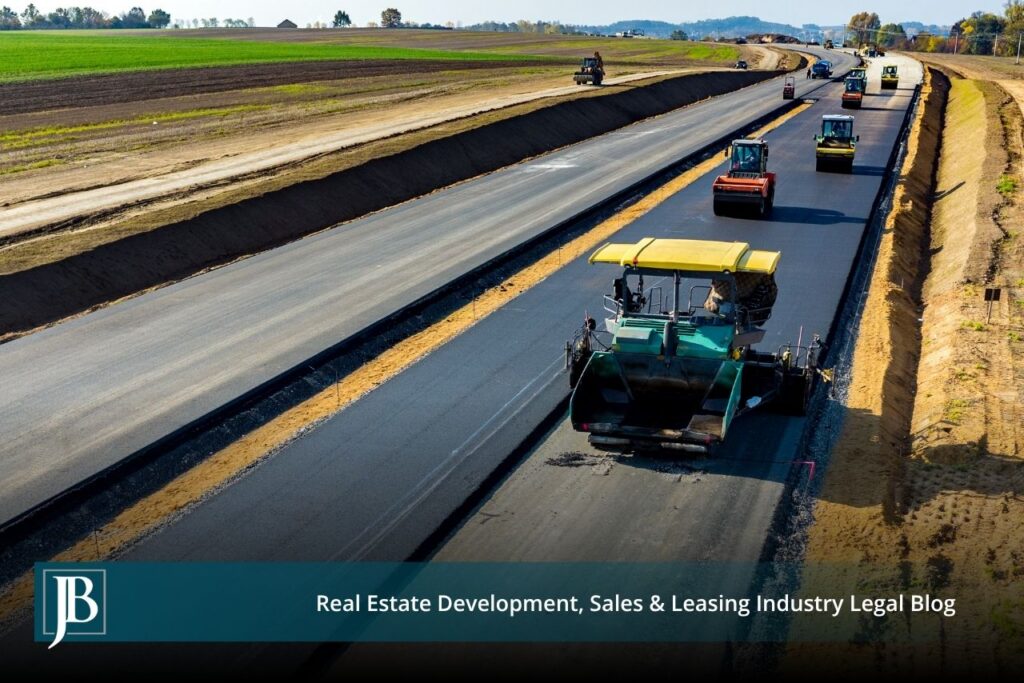
The Suncoast Parkway Extension has moved past the stage most property owners worry about. Right of way for the current phases was acquired years ago, and the corridor is now in active construction through Citrus County. If you own along this corridor, your exposure today is less about a first offer and more about what construction does to access, drainage, and value on the land you kept.
That distinction matters, because the two situations call for completely different responses. Here is the plain-English brief our Tampa office gives property and business owners along this corridor.
Where Does the Suncoast Parkway Extension Actually Stand?
In construction, with acquisition for the funded phases already behind it.
According to Florida’s Turnpike Enterprise, the published schedule for Phase 3 set right-of-way acquisition as a Q4 2023 milestone for Phase 3A and Q2 2024 for Phase 3B. Construction follows acquisition because right of way must be certified before a segment is let.
FDOT’s own announcement sets the rest of the timeline:
- Phase 2, three miles from SR 44 to W. Norvell Bryant Highway/CR 486, a $103 million project, opened August 25, 2025, more than 500 days ahead of schedule.
- Phase 3A, from CR 486 to CR 495, a $244 million project, began construction in mid-August 2025 and will run approximately five years.
- Phase 3B, from CR 495 to US 19 in Red Level, a $192 million project, was scheduled to begin construction in mid-2026.
Phase 3 runs approximately 10 miles and includes new interchanges at CR 495 and US 19, a completed full interchange at CR 486, realignment of W. Dunnellon Road, and continuation of the Suncoast Trail.
All of this work is in Citrus County. Owners in Hernando County are south of the current construction limits and are not in the path of these phases.
If Acquisition Is Done, What Should Owners Watch Now?
Construction impacts, remainder value, and any residual parcel needs that surface as design is finalized.
Owners who already conveyed land or granted a temporary construction easement still have live issues. Owners who were never contacted may still see effects. The categories worth tracking:
- Temporary construction easement performance. If you granted a TCE, check that the term, the footprint, and the restoration obligations are being honored. Overstay and overreach are compensable.
- Access and driveway changes. Interchange and frontage work can move a curb cut or eliminate a turn movement well after the deed is recorded.
- Drainage and stormwater. New retention, grading, and outfall changes can put water where it did not previously go.
- Damage without a taking. If construction floods, undermines, or cuts off property the agency never acquired, that is an inverse condemnation question, not a condemnation defense.
- Assessed value. A parcel that lost land or usability should not carry its old tax bill, which is a valuation issue worth raising with the property appraiser.
What Does Full Compensation Include in Florida?
More than the dirt, and this remains true whenever a Florida taking does occur.
The U.S. Constitution requires “just compensation.” Florida goes further. Article X, Section 6 of the Florida Constitution, implemented through Chapter 73 of the Florida Statutes, requires full compensation, which Florida courts read to mean the owner should be placed in the same financial position as if the taking had never occurred.
In practical terms, full compensation can include:
- Fair market value of the land and improvements taken.
- Severance damages to the remainder when only part of a parcel is taken and what is left loses value through lost access, awkward shape, drainage changes, visibility loss, or parking impacts.
- Cost-to-cure items such as new signage, replacement parking, re-engineered driveways, retention pond rework, fencing, and utility relocations.
- Business damages under Florida Statute s. 73.071(3)(b) for established businesses meeting the statutory criteria.
- Improvements to real property such as canopies, fuel systems, irrigation, and specialized fixtures.
- Reasonable attorney’s fees and expert costs under Florida Statute s. 73.092, paid by the condemning authority in a filed case.
For a deeper dive on how these stack, see our pieces on business damages in Florida eminent domain, calculating and proving business damages, severance damages when the remainder loses value, and the broader eminent domain process for Florida commercial property owners.
Business Damages Require Five Years, Not Four
Florida is one of a small number of states that compensates lost business profits, and the eligibility threshold is precise.
Section 73.071(3)(b) requires an established business of more than 5 years’ standing on adjoining land the owner owns or holds, for takings on or after July 1, 1980, with damages reasonably proven. For family-run operations in Lecanto, Beverly Hills, Crystal River, and Inverness, this category can exceed the dirt value, which is exactly why the five-year threshold is worth confirming against your own records before anyone relies on it. We covered the current rules in Florida’s New Eminent Domain Rules for Business Owners.
What Is the State’s First Offer, and When Does It Come?
It comes before suit, and it is a starting position rather than a valuation.
Before FDOT or the Turnpike Enterprise files a condemnation lawsuit, it must follow a presuit process. The general sequence:
- Notice of project and survey access. Right-of-way agents introduce themselves, request survey access, and identify affected parcels.
- Appraisal. An appraisal is ordered covering the part to be taken and any severance damages.
- Written offer. A written offer based on that appraisal. This is the first offer.
- Negotiation period. The owner has a window to respond, counter, or request more information, including the appraisal itself.
- Order of Taking, if no agreement. Under Chapter 74 quick-take, the agency files suit, deposits its good-faith estimate with the court, and obtains an order transferring title and possession before compensation is decided.
- Trial on compensation. Decided by a 12-person jury under section 73.071 unless settled.
The first offer is rarely the number a jury would award. It is a good-faith estimate that routinely omits temporary construction easements, cure costs, business damages, and remainder impairment. For more on that phase, see our discussion of pre-trial settlement strategies in eminent domain proceedings.
Which Issues Recur Along This Corridor?
Temporary Construction Easements
A TCE gives the agency or its contractors the right to enter for staging, grading, drainage, or driveway tie-ins for a defined period. They are compensable, and rental value plus operational disruption can be substantial. Owners routinely undervalue them because the word “temporary” makes them sound minor. Our breakdown is here: Navigating Temporary Construction Easements in Florida’s Eminent Domain Process.
Access and Driveway Reconfiguration
A partial taking can re-engineer a driveway, eliminate a turn movement, or push a curb cut hundreds of feet. The land area may be modest while the damage to a fuel station, drive-through, or destination retail site is severe. Severance damages and cost-to-cure analysis matter more than the square footage of dirt.
Loss of Visibility and Signage Rights
Elevated mainline, sound walls, retention basins, and frontage reconfigurations change visibility from the parkway and the local network. Florida law recognizes severance damages when remainder visibility is impaired and signage rights are affected. See our related analysis on signage, easements, and facility usage disputes.
Boundary, Title, and Easement Cleanup
Rural parcels in Citrus County frequently carry old surveys, unrecorded encroachments, and prescriptive easements. These should be resolved before a condemnation, not during one. See boundary line and quiet title issues, and note that recorded easements and restrictive covenants affect both what is taken and what value remains.
Remainder Strategy
If the remaining property is still developable, the valuation conversation shifts. A thoughtful highest-and-best-use analysis on the remainder, including retail, office, industrial, hotel, and multi-residential redevelopment options, can reshape the math considerably. A new interchange at CR 495 or US 19 changes what adjacent land is worth.
Eminent Domain or Condemnation: Which Word Is Right?
Both, for different things. “Eminent domain” is the government’s underlying power. “Condemnation” is the legal proceeding used to exercise it. We unpacked the distinction in Eminent Domain vs. Condemnation: What Business Owners Need to Understand.
On public purpose, toll-road expansion by a state authority is generally treated as a public use, though the way contractors, public-private partnerships, and adjacent commercial development connect to a project can affect strategy. Background reading: The Renewed Debate Over Eminent Domain for Private Infrastructure Projects.
What Should I Do If an Agency Does Contact Me?
Given where this project stands, contact would most likely concern a residual parcel need, an easement modification, or a construction impact. Either way:
- Preserve documents. Deeds, surveys, title policy, all leases and subleases, franchise agreements, mortgage documents, environmental reports, and prior appraisals.
- Map the operation. Photograph and video the property, including signage, lighting, drainage, parking, and peak-hour traffic patterns.
- Do not sign access agreements without review. Consent forms routinely waive compensation.
- Track financials. Five years of profit and loss statements, tax returns, and sales reports tied to the location, which is what the statutory business damages threshold requires.
- Get the project documents. Construction plans, right-of-way maps, and design drawings show what is actually happening. Most owners have never seen them.
- Engage counsel. Coordinate with experienced eminent domain counsel and Florida appraisers, engineers, and accountants who regularly testify in condemnation cases.
Frequently Asked Questions
Can the State take my property even if I refuse to sell? Yes, through the Order of Taking process under Chapter 74. The fight is not whether the taking happens, but what you are paid and on what terms.
Do I have to pay my attorney out of pocket? In a filed Florida condemnation case, reasonable attorney’s fees and expert costs are generally paid by the condemning authority under s. 73.092, calculated on the benefit achieved above the last written offer made before counsel was retained. That fee-shifting operates inside a condemnation proceeding. A purely negotiated sale or voluntary easement grant that never becomes a filed case does not carry the same statutory entitlement, so confirm the fee structure with counsel in writing.
Will the State’s appraisal include my business losses? Usually no. The first offer typically focuses on land and improvements. Business damages, cost-to-cure, and certain severance components are often added later, sometimes only after a formal claim is presented.
What about leases and tenants on my property? Tenants generally have their own compensable interests, and lease language drives how proceeds are divided. We address these in tandem with the owner’s claim.
How long does the process take? From first contact to resolution, six months to several years. Quick-take possession can occur within months of suit, with compensation litigation continuing afterward.
How Jimerson Birr Helps Owners Along the Corridor
Our eminent domain practice represents Florida property owners, operators, and tenants from the Tampa Bay region north through Citrus County and across the state. We coordinate appraisers, engineers, planners, accountants, and forensic business-damages experts to build a record reflecting the real value of what is taken and what is left behind. We also handle the real estate cleanup that surfaces during condemnation, including boundary line disputes, easement issues, and complex real property improvement matters.
Construction is not the end of a property owner’s rights. It is often where the remainder problems finally become visible. If the Suncoast Parkway Extension has affected your property or your business, contact our Tampa team for a confidential conversation about your options.