


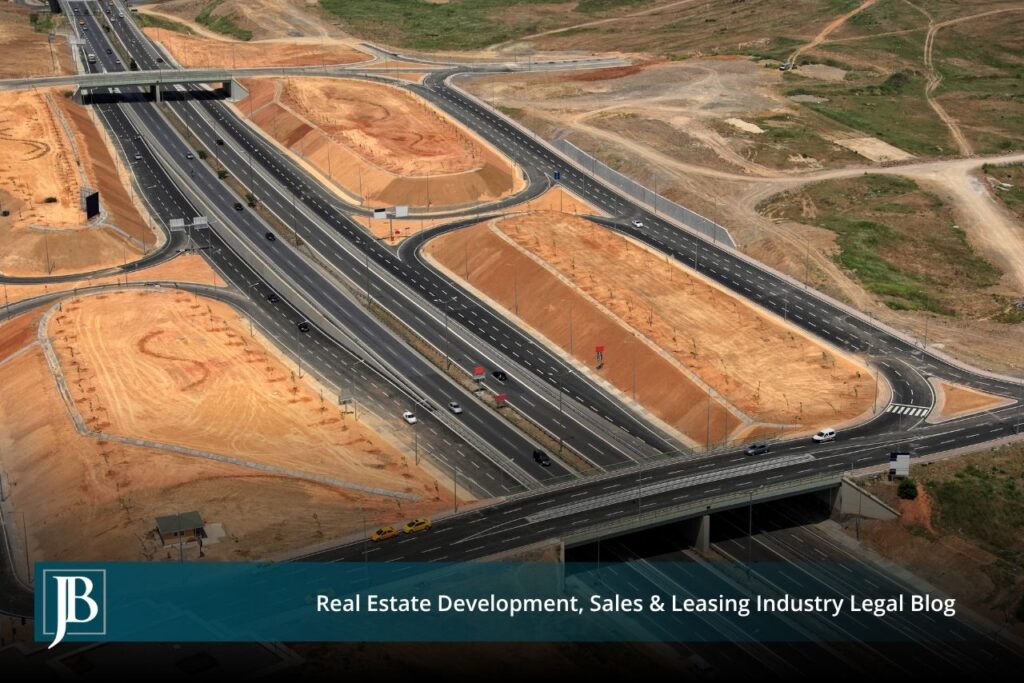
The First Coast Expressway is no longer a line on a planning map, and it is no longer in the land-buying phase either. Every remaining segment is under construction with a contractor at work. If the corridor took part of your land, the question now is not whether it happens. It is whether you have been paid what Florida law actually owes you, because on this project title often passed long before compensation was finally determined.
That distinction is the whole point of this article. Owners who assume the case ended when the check hit the court registry are the ones who leave the most money behind.
Where Does the First Coast Expressway Stand Today?
In construction across every remaining segment, with right of way already certified.
Designated State Road 23, the FCE is an FDOT and Florida’s Turnpike Enterprise project running roughly 46 miles from Interstate 10 in Duval County south through Clay County, across a new bridge over the St. Johns River, and east through St. Johns County to Interstate 95. According to FDOT’s project page:
- Segment 1, Blanding Boulevard to I-10 in Duval County, was completed in summer 2019, with tolling beginning July 13, 2019.
- Segment 2 was split into two projects. The north project (FIN 422938-6, Sacyr Construction, $230 million) began construction in March 2019. The south project (FIN 422938-5, Superior Construction, $180 million) began in April 2019. Both were scheduled for completion in 2025, and the Clay County corridor is open.
- Segment 3 consists of the new St. Johns River bridge (FIN 422938-7), which began construction in early 2023 at roughly $595 million with completion estimated in 2030; the roadway from east of the CR 16A Spur to CR 2209, with construction starting late 2024; and the final roadway from CR 2209 to I-95, with construction starting early 2026.
Because right of way must be certified before a construction contract is let, acquisition for each of these segments preceded its construction start. Owners in the corridor are past the offer stage, not approaching it. Florida’s Turnpike Enterprise maintains a corridor overview on its First Coast Expressway page.
If Title Already Passed, Is My Case Over?
No, and this is the most valuable thing an FCE landowner can understand.
Florida road projects are acquired through quick-take under Chapter 74. FDOT deposits a good-faith estimate with the court, the judge enters an order of taking, and title passes. Construction then begins while the fight over how much you are owed continues.
That means an owner in the FCE corridor can be in any of these positions right now:
- Title passed, compensation still open. The deposit was the state’s estimate, not the final number. Negotiation, settlement, or a jury determines full compensation, and awards frequently exceed the deposit.
- Deposit withdrawn, case continuing. Withdrawing the deposit does not accept the state’s valuation. It just stops your own money from sitting idle in the registry.
- Apportionment unresolved. Where a parcel has multiple interests, a mortgage, a lease, a life estate, or co-owners, the award still has to be divided.
- Business damages claim pending or lost. The 180-day deadline to submit a good-faith business damages offer is unforgiving, and missing it without good cause lets a court strike the claim.
- Construction damage without a taking. Flooding, access loss, or vibration damage on land FDOT never acquired is an inverse condemnation question, not a condemnation defense.
Our step-by-step walkthrough of the quick-take process under Chapter 74 tracks each deadline, and Understanding the Eminent Domain Process for Florida Commercial Property Owners covers the sequence end to end.
What Does Full Compensation Actually Include in Florida?
More than the strip of dirt. The Fifth Amendment requires just compensation. Florida’s Constitution requires full compensation, which is broader, and that difference is where owners recover real money.
Value of the Land Actually Taken
Fair market value of the strip, wedge, or whole parcel acquired, valued at its highest and best use, not merely its current use. A pasture that could lawfully be subdivided is not appraised as raw pasture.
Severance Damages to the Remainder
If only part of your land was taken, the remainder may have lost value. Common drivers on a limited-access highway:
- Loss of frontage on a county road.
- Loss of direct access, where a driveway is now blocked by a limited-access fence.
- Noise, light, and visual impacts from a new elevated lane.
- Awkward configurations leaving the remainder hard to develop.
- Drainage and stormwater changes that flood or impair the remainder.
The interplay between the value of the take and severance damages is the single most heavily litigated area in Florida condemnation work, and on a corridor with a 65-foot-high bridge approach it is where the largest numbers live. See our detailed treatment of severance damages in Florida and our discussion of Complex Real Property Improvement Issues.
Business Damages
Florida is one of a few states allowing business damages in a partial-take case. Under section 73.071(3)(b) of Chapter 73, the owner of an established business of more than 5 years’ standing on the property may recover lost profits and diminution in business value caused by the taking, even though the business itself was not condemned.
This matters along the FCE. The family-run nursery on Henley Road, the boat dealer on County Road 220, the grove with a roadside stand, the auto repair shop on State Road 16, the storage facility off County Road 210. Each may hold a business damages claim distinct from the real estate claim. Our two-part series, An Introduction to Business Damages and Calculating and Proving Business Damages, explains the prerequisites and the math.
Cost-to-Cure
Where harm to the remainder can be fixed, rebuilding a fence, drilling a new well, relocating a sign, repaving a driveway, regrading a swale, those costs are compensable. An owner does not have to choose between cost-to-cure and severance damages. Done right, the analysis pairs them so the remainder is left as economically whole as possible.
Attorneys’ Fees and Expert Costs
In a filed Chapter 73 case, FDOT generally pays the landowner’s reasonable attorneys’ fees and expert costs under a statutory formula tied to the difference between the initial offer and the ultimate award.
The Legislature built it that way so owners could afford professional representation without it eating their compensation. One limit worth stating: that fee-shifting operates inside a condemnation proceeding. A purely negotiated sale that never became a filed case does not carry the same statutory entitlement.
Temporary Construction Easements: Small Print, Big Impact
A temporary construction easement lets FDOT and its contractors enter your remaining land for a defined period. They sound minor. They are not, and on this corridor they are currently being used rather than negotiated.
A TCE can mean heavy equipment in a front pasture for 18 months, the loss of a row of mature oaks, blocked access to a back parcel, or compaction damage lingering long after the contractor leaves. If you granted one, check the term, the footprint, and the restoration obligations against what is actually happening on the ground. Overstay and overreach are compensable. We covered the strategic issues in Navigating Temporary Construction Easements in Florida’s Eminent Domain Process.
Watch for:
- Duration. An expired TCE that contractors are still using is a live claim.
- Scope. Activities beyond what the grant permits.
- Surface restoration. Restoration to pre-construction grade and condition.
- Compensation. A TCE is a property interest, and you are entitled to be paid for it.
What About Damage to Property FDOT Never Took?
That is a separate remedy, and it is easy to miss.
Corridor construction can cause flooding, loss of access, or vibration damage on parcels the agency never acquired. Regulatory action can devalue property without any physical taking at all. The Bert Harris Act provides relief in some situations where government action devalues property without a formal taking, and it sometimes runs in parallel with a Chapter 73 case.
Florida has also tightened the rules on what governments can do with condemned property. Our overview of Florida’s New Eminent Domain Rules addresses how post-Kelo statutory reforms limit downstream conveyances.
What Should FCE Corridor Owners Do Now?
The checklist has shifted from pre-offer preparation to preserving and proving what you are still owed.
- Find out where your case actually stands. If title passed, confirm whether compensation was finally determined or merely deposited. Owners routinely assume a closed file that is not closed.
- Inventory what changed. Document existing access points, drainage, fences, wells, septic, outbuildings, and signage against pre-construction conditions. Photos and dated drone footage are gold.
- Pull your business financials. Three to five years of tax returns and financials. Business damages claims rise and fall on this data, and the five-year standing requirement is proven with records.
- Check TCE performance. Compare the grant terms to what is happening on your land.
- Clean up title and boundaries. Existing easements and restrictive covenants, unresolved boundary line issues, and quiet title issues affect apportionment.
- Do not talk to FDOT or its contractors without counsel. Casual statements about a property’s use or condition become exhibits.
For broader context on protecting development-grade land, see Property Owners and Real Estate Developers and Disputes Involving Easements, Facility Usage, Signage and Security Matters.
What Mistakes Cost Landowners the Most?
- Treating the deposit as the final award. It is the state’s estimate, not a jury’s verdict.
- Assuming the appraiser saw what you see. If the appraisal missed business operations, drainage, or a higher-and-better-use case, the number was low.
- Missing the 180-day business damages deadline. This forfeits a valuable, separate claim.
- Forgetting the remainder. Severance damages and cost-to-cure are where the biggest dollars usually sit.
- Ignoring TCE terms during construction. A poorly drafted or overrun TCE permits far more contractor activity than the owner envisioned.
- Assuming it is too late. On a corridor where title passed years ago, compensation litigation and apportionment may still be open.
Our piece on Pre-Trial Settlement Strategies in Eminent Domain Proceedings walks through how positioning changes the trajectory of a case.
A Note for Developers and Investors Along the Corridor
If you hold land for future use near the FCE, the taking is only half the story. New interchanges create winners and losers. Land directly at an interchange may double in value, while land a quarter mile back behind a sound wall may lose visibility entirely.
Owners and operators should be thinking about highest and best use reanalysis now that the corridor is fixed, condemnation provisions in commercial leases and how the award is allocated between landlord and tenant, refinancing and lender consent where a partial taking triggered loan covenants, and tax planning around any award.
Bottom Line
The First Coast Expressway is being built, and the acquisition phase is behind it. That does not mean the money is settled. Florida’s framework gives owners real leverage well after title passes, through compensation litigation, apportionment, business damages, TCE enforcement, and inverse condemnation for damage to land that was never taken.
If your property in Jacksonville, St. Augustine, Duval County, Clay County, or St. Johns County was touched by the First Coast Expressway, our eminent domain attorneys can tell you whether your file is genuinely closed or only appears to be. Learn more about our eminent domain and condemnation practice.