

Can a Jury Really Say This Is Not Copyright Infringement?
Reading Time: 5 minutes
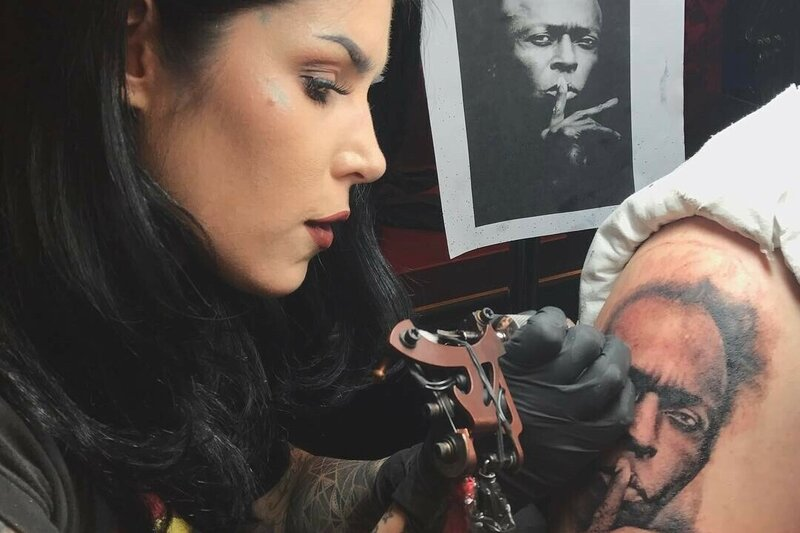
A photographer holds a copyright in a picture of Miles Davis. A tattoo artist stenciled that picture onto a client’s arm and reproduced the picture as a tattoo. Can a jury really say that is not copyright infringement?
Business owners ask this question more often than they realize. Usually not about tattoos or photographs, but about ads, websites, product visuals, social media posts, or marketing materials that look uncomfortably close to something else.
A recent federal appellate decision out of the Ninth Circuit puts that concern into sharp focus. See Sedlik v. Drachenberg, No. 24-3367, 2026 LX 64931 (9th Cir. Jan. 2, 2026). The case involved a well-known photograph, a tattoo artist, and a jury verdict finding no copyright infringement even though the artist traced the photograph to create a stencil and used it directly during the tattooing process. Photos of that process were posted online. The jury concluded there was no infringement because, in its view, the “concept and feel” of the tattoo differed from the photograph.
Two appellate judges openly questioned whether that result makes sense under copyright law.
For business owners, the takeaway is not about tattoos. It is about how copyright risk is evaluated, how unpredictable outcomes can be, and why strategy matters before a dispute ever reaches a jury.
What Actually Happened
The copyrighted work was a professional photograph of a famous musician. The tattoo artist did not merely glance at it for inspiration. She traced the photograph to create a stencil. The stencil was transferred directly onto a client’s arm. The photograph was displayed side by side during the tattooing process. The process was documented and shared publicly.
At trial, the jury was shown both the photograph and the resulting tattoo. The jury still found no copyright infringement, reasoning that the overall “concept and feel” of the works were different.
On appeal, the Ninth Circuit affirmed the verdict because existing precedent requires deference to jury determinations on this subjective question. But two judges wrote separately to express serious concern that copyright cases are being decided based on impression rather than law.
Their criticism was blunt. Asking juries whether two works “feel” similar risks untethering copyright law from the legal boundaries that are supposed to define it.
Why This Should Concern Businesses
Most copyright disputes involving businesses do not look like this case on the surface. They involve:
- Website layouts
- Product photography
- Packaging
- Advertising graphics
- Social media campaigns
- Rebranded or “updated” marketing materials
- Content created by vendors, agencies, or contractors
But the underlying issue is the same. When does lawful inspiration become unlawful copying?
If the answer depends on how a jury reacts emotionally to two works, rather than on a disciplined legal analysis of what copyright protects, risk becomes difficult to predict. And unpredictable risk is bad for business.
Business owners plan around costs, probabilities, and exposure. Copyright law is supposed to provide boundaries that make that planning possible. When outcomes hinge on subjective impressions, those boundaries blur.
The Problem With “Concept and Feel”
Copyright law does not protect ideas, concepts, styles, or general aesthetics. It protects specific expression.
In theory, courts are supposed to filter out unprotected elements and compare only what is legally protectable. In practice, some courts ask juries to decide whether two works share a similar “concept and feel.” That phrase sounds intuitive, but it is dangerously vague.
Two works can feel similar because they share unprotected elements like subject matter, genre, or common design conventions. They can also feel different because they appear in different media or contexts, even when protectable expression has been copied.
The judges who criticized the tattoo decision made exactly this point. A jury’s subjective impression can mask copying that would be obvious under a careful legal analysis.
For businesses, this means that even clear evidence of copying does not guarantee a predictable outcome once a case reaches trial.
Why The Eleventh Circuit Approach Matters
Businesses operating in Florida, Georgia, and Alabama benefit from a generally more disciplined analytical approach in copyright cases.
Courts in the Eleventh Circuit tend to emphasize filtering out unprotected elements and focusing on protectable expression. Summary judgment is more common where similarities relate only to ideas, common phrases, or standard design features.
That does not mean copyright claims fail automatically. It means courts are more likely to ask the right question before a jury ever gets involved.
But many businesses operate nationally. Marketing campaigns cross state lines. Websites are accessible everywhere. A dispute may land in a forum that applies a more subjective framework.
Understanding that risk matters at the planning stage, not just after a cease-and-desist letter arrives.
What Business Owners Should Take From This Case
The tattoo case illustrates several practical lessons.
First, copying can be found lawful even when it feels obvious. That should caution businesses against assuming a dispute will resolve cleanly in court.
Second, relying on a jury to “see it your way” is a risky strategy. Jurors are not trained to separate protected expression from unprotected ideas, and courts often instruct them not to overanalyze.
Third, copyright exposure is often created upstream. Vendors, designers, agencies, and freelancers may reuse references or prior work in ways that expose the business rather than themselves.
Fourth, early legal review is cheaper than litigation. Identifying risk before content is published or distributed is far less expensive than defending a lawsuit years later.
The Real Business Question
The right question is not “would a jury side with us.”
The better question is “how much uncertainty are we willing to tolerate.”
Copyright law is not purely mechanical, but it is not supposed to be arbitrary either. When courts themselves express concern about subjectivity, businesses should pay attention.
If creative assets drive revenue in your business, a copyright strategy is not optional. It is part of risk management, brand protection, and long-term planning.
And it is most effective when addressed before someone else decides to test the boundaries for you.
To protect your original content, contact Jimerson Birr.